2026 NECO GCE PHYSICS ANSWER
PHYSICS OBJ
Trace answer wordings to your question options
1. microwave
2. minimize heat loss from the absorber plate
3. 720 ms⁻¹
4. 4.8
5. 1/32
6. motion, field and current
7. 17.0 Hz
8. 20 N
9. II only
10. Pupil – Aperture
11. 0.67
12. Thermionic emission and Compton effect
13. 250 m
14. Cloud → Rain
15. does not depend on the nature of material while friction does
16. is a helium nuclei
17. 5.12 mm
18. 30°
19. 10 N
20. 120.0 mm
21. 5.0 × 10⁻⁷ kg C⁻¹
22. Wind
23. is connected in parallel with a resistor
24. gave explanation for hydrogen spectrum while Rutherford's model did not
25. 187.50 V
26. 3 ms⁻¹
27. friction in its parts
28. Density, speed and mass
29. 4 Hz
30. help the rocket to travel straight
31. 250 mmHg
32. two parallel plates symbol (⊣⊢)
33. I
34. a pendulum bob in motion
35. I only
36. I, II and III
37. is in phase with the voltage
38. at infinity
39. 22Rr²/7ρ
40. ½mv²
41. 4 eV
42. 100 K
43. 6.7
44. 80°
45. the funnel-shaped object resting on its point
46. 3.83 s
47. 3.72 × 10²² N
48. 1.50 s
49. Three new bar magnets are created
50. Its input voltage is higher than the output voltage
51. II only
52. 27th September, 2003
53. I, II and III
54. telescope
55. 75 °C
56. 10.0 rads⁻²
57. 3.00 × 10⁻¹⁹ J
58. I and III only
59. Neutron
60. Grease
=============================
2026 NECO GCE PHYSICS THEORY ANSWER
QUESTION 1 (5 marks)
(a) State the corresponding quantity, industrial and S.I. units for measuring the following:
Quantity: Area
Industrial Unit: Hectare
S.I. Unit: m² (square metre)
Quantity: Volume of crude oil
Industrial Unit: Barrel
S.I. Unit: m³ (cubic metre)
(b) When is an astronomical telescope said to be in normal adjustment?
An astronomical telescope is said to be in normal adjustment when the final image is formed at infinity. This occurs when the distance between the objective lens and the eyepiece is equal to the sum of their focal lengths (f_o + f_e).
(c) A transformer connected to a device supplied 12 V. If the voltage of the a.c. source is 240 V and the current in the primary coil is 0.04 A, calculate the current drawn by the device.
For an ideal transformer: V_p × I_p = V_s × I_s
240 × 0.04 = 12 × I_s
9.6 = 12 × I_s
I_s = 9.6 / 12 = 0.8 A
Answer: 0.8 A
============================
QUESTION 2
(a) State two examples of objects in stable equilibrium.
1. A cone resting on its base.
2. A book lying flat on a table.
(b) Two forces of magnitude X and 10 N are perpendicular to each other. If the magnitude of their resultant is 12.81 N, calculate the magnitude of X.
Resultant R = √(X² + 10²)
12.81² = X² + 100
164.1 = X² + 100
X² = 64.1
X = √64.1 = 8.0 N
Answer: 8.0 N
=============================
QUESTION 3
(a) What happens to the velocity of a ball thrown vertically upward?
The velocity decreases uniformly (due to the downward acceleration of gravity) until it reaches zero at the maximum height.
(b) A stone is projected horizontally from the top of a tower 125 m high with an initial velocity of 10 m/s. Calculate the time taken to reach the ground. [g = 10 m/s²]
Vertical motion: h = ½gt²
125 = ½ × 10 × t²
125 = 5t²
t² = 25
t = 5 s
Answer: 5 s
============================
QUESTION 4
(a) State a similarity between conduction and convection.
Both are methods of heat transfer that require a material medium (they cannot occur in a vacuum).
(b) An object of mass 10 kg moves at a constant velocity V. If its kinetic energy is 1125 joules, calculate the value of V.
K.E. = ½mV²
1125 = ½ × 10 × V²
1125 = 5V²
V² = 225
V = 15 m/s
Answer: 15 m/s
============================
QUESTION 5
(a) Classify the following into elastic or inelastic collision:
(i) Collision of molecules: Elastic collision (kinetic energy is conserved).
(ii) A bullet hitting a wooden block: Inelastic collision (they stick together; kinetic energy is lost).
(b) Give two applications of Newton's third law.
1. Recoil of a gun.
2. Propulsion of a rocket.
============================
QUESTION 6
(a) List two applications of concave mirrors.
1. Used as shaving mirrors (to give a magnified virtual image).
2. Used in headlamps and searchlights (to reflect light into a parallel beam).
(b) A ray of light makes an angle of 60° to the surface of a plane mirror. If the mirror is rotated 20° away from the ray, determine the angle of reflection.
Initial angle to surface = 60°. Angle of incidence i_1 = 90° - 60° = 30°.
If mirror rotates 20° away from the ray, the new angle to surface becomes 60° + 20° = 80°.
New angle of incidence i_2 = 90° - 80° = 10°.
Since angle of reflection = angle of incidence, the new angle of reflection is 10°.
=============================
QUESTION 7
(a) What is a real image?
A real image is an image formed by the actual intersection of light rays, which can be projected onto a screen.
(b) The first and second positions of resonance in a resonance tube are 52.3 cm and X respectively, when a vibrating turning fork of 512 Hz was used. If the speed of sound in air is 340 m/s, determine X.
Distance between first and second resonance d = λ/2.
v = fλ => λ = v/f = 340/512 = 0.664 m = 66.4 cm.
X - 52.3 = 66.4/2 = 33.2 cm.
X = 52.3 + 33.2 = 85.5 cm.
Answer: 85.5 cm
============================
QUESTION 8
Two capacitors of capacitances 2 μf and 4 μf are connected in parallel across a 420 V source. Calculate the:
(i) Equivalent capacitance
For parallel connection: C_eq = C₁ + C₂ = 2μF + 4μF = 6μF.
Answer: 6 μF (or 6 × 10⁻⁶ F)
(ii) Total charge on the capacitors
Q = C_eq × V = 6 × 10⁻⁶ × 420 = 2.52 × 10⁻³ C.
Answer: 2.52 × 10⁻³ C (or 2.52 mC)
============================
QUESTION 9
With the aid of a diagram, describe the conversion of a metal rod to a magnet by electrical method.
Description (Electrical Method):
A long metal rod (e.g., steel) is wrapped with an insulated copper wire to form a solenoid. A direct current (D.C.) is passed through the coil. The magnetic field generated by the current aligns the magnetic domains within the metal rod. When the current is switched off, the rod retains magnetism.
(Diagram Description: Draw a straight rod wrapped with coils. Connect the ends of the wire to a battery. Use an arrow to show current direction. Label: Steel rod, Insulating copper wire, Battery).
============================
QUESTION 10
State three conclusions that can be drawn from Rutherford's experiment on the scattering of alpha particles by a thin metal foil in relation to the structure of the atom.
1. The atom is mostly empty space (since most alpha particles passed straight through).
2. The center of the atom contains a tiny, dense, positively charged nucleus (since a few were deflected at large angles).
3. The nucleus contains almost all the mass of the atom (since particles that hit it bounced back).
============================
QUESTION 11
(a) Define cohesion.
Cohesion is the force of attraction between molecules of the same substance.
(b) State the difference between simple cubic and face-centred cubic crystals.
In a simple cubic crystal, atoms are located only at the eight corners of a cube (1 atom per unit cell). In a face-centred cubic crystal, atoms are located at the eight corners and at the center of each of the six faces (4 atoms per unit cell).
============================
PART II
Answer four questions from this part.
QUESTION 12
(a)(i) Similarity between energy and force:
Both are scalar quantities that can cause a change in the state or motion of an object.
(a)(ii) Difference between energy and force:
Energy is the capacity to do work (measured in Joules), while force is a push or pull that changes motion (measured in Newtons).
(b) Why is a metre rule preferred to vernier calliper in measuring the length of a thread in the laboratory?
A metre rule is preferred because a thread is flexible and can be laid straight along the rule, making it easier to measure its total length. A vernier calliper is designed to measure small, rigid dimensions (like diameter or thickness) and would be cumbersome for a long, flexible thread.
(c) State the difference between linear velocity and linear acceleration.
Linear velocity is the rate of change of displacement (speed in a specific direction), while linear acceleration is the rate of change of velocity.
(d) A body moving with simple harmonic motion in a straight line has instantaneous displacement y = 3.0 sin(0.5t). Calculate the magnitude of its angular velocity.
(Assuming the equation is y = 3.0 sin(0.5t) where the standard form is y = A sin(ωt)).
Comparing y = 3.0 sin(0.5t) with y = A sin(ωt), the angular velocity ω = 0.5 rad/s.
Answer: 0.5 rad/s
============================
QUESTION 13
(a)(i) State one difference between boiling and sublimation.
Boiling is the change of state from liquid to gas, while sublimation is the change of state directly from solid to gas without passing through the liquid state.
(a)(ii) State two advantages of mercury as a thermometric liquid.
1. It is opaque, making it easy to read.
2. It has a high boiling point and low freezing point, providing a wide temperature range.
(b) Classify the following machines according to their classes of lever:
(i) Crowbar: First class lever.
(ii) Tongs: Third class lever.
(iii) Forceps: Third class lever.
(iv) Bottle opener: Second class lever.
(c) A block and tackle system of pulleys with velocity ratio of 4 is used to raise an object of mass 30 kg through a vertical distance of 3 m. If the effort applied is 120 N, calculate the:
(i) Distance moved by the effort
V.R. = (Distance moved by effort) / (Distance moved by load)
4 = d_E / 3 => d_E = 12 m.
Answer: 12 m
(ii) Work done in lifting the load
Work = Force × distance = (m × g) × h
Work = (30 × 10) × 3 = 300 × 3 = 900 J.
Answer: 900 J
============================
QUESTION 14
(a) Draw a wave form that is one wavelength.
(Draw a single complete wave cycle: a crest and a trough, starting from zero, going up, down past zero, and back to zero).
(b) Define quality of a musical note.
Quality (or timbre) is the characteristic of a musical note that distinguishes it from another note of the same pitch and loudness, due to the presence of different overtones (harmonics).
(c) Why is the image of a pinhole camera bright when the pinhole size is small?
A small pinhole restricts light to a narrow beam, creating a sharper image. However, brightness depends on the amount of light passing through. A larger pinhole makes the image brighter (though less sharp). If the question implies a small pinhole makes a clear image, it's due to reduced blurring.
(d)(i) What is meant by the statement, 'the refractive index of water is 4/3'?
It means that the ratio of the speed of light in a vacuum (or air) to the speed of light in water is 4:3.
(d)(ii) An object is viewed directly from the top of a swimming pool 6 m deep. Calculate the apparent depth of the object. [Refractive index of water = 4/3]
n = (Real depth) / (Apparent depth)
4/3 = 6 / Apparent depth
Apparent depth = (6 × 3) / 4 = 4.5 m.
Answer: 4.5 m
============================
QUESTION 15
(a)(i) Differentiate between a shunt and a multiplier.
A shunt is a low resistance connected in parallel with a galvanometer to convert it into an ammeter. A multiplier is a high resistance connected in series with a galvanometer to convert it into a voltmeter.
(a)(ii) State the mathematical relationship between conductivity and resistivity.
σ = 1/ρ (Conductivity is the reciprocal of resistivity).
(b) Explain the working principle of an a.c. generator.
An a.c. generator works based on the principle of electromagnetic induction. A coil is rotated in a magnetic field. As the coil rotates, the magnetic flux linking it changes continuously, inducing an alternating electromotive force (e.m.f.) in the coil.
(c) Calculate the magnitude of the force exerted on a 10 C charge by a -15 C and 12 C charges represented in the diagram below:
(Assume the diagram shows a 10 C charge with a 12 C charge 2m to its right, and a -15 C charge 3m directly below it).
Force due to 12 C charge (F₁):
F₁ = (k q₁ q₂) / r² = (9 × 10⁹ × 10 × 12) / 2² = (1080 × 10⁹) / 4 = 270 × 10⁹ = 2.7 × 10¹¹ N (Repulsive, to the left).
Force due to -15 C charge (F₂):
F₂ = (k q₁ q₃) / r² = (9 × 10⁹ × 10 × 15) / 3² = (1350 × 10⁹) / 9 = 150 × 10⁹ = 1.5 × 10¹¹ N (Attractive, downwards).
Resultant Force (F):
F = √(F₁² + F₂²) = √((2.7 × 10¹¹)² + (1.5 × 10¹¹)²)
F = 10¹¹ √(7.29 + 2.25) = 10¹¹ √9.54 = 3.09 × 10¹¹ N.
Answer: 3.09 × 10¹¹ N
============================
QUESTION 16
(a) The diagram below shows nuclear radiations in an electric field.
(i) Identify A, B and C:
A is the positive plate (anode).
B is the radioactive source (e.g., Radium).
C is the negative plate (cathode).
(ii) State the effect of electric field on M, N and O:
M (Alpha particles) is deflected towards the negative plate (C).
N (Gamma rays) is undeflected (travels straight).
O (Beta particles) is deflected towards the positive plate (A).
(iii) Mention a detector for M:
A zinc sulphide screen (or a cloud chamber).
(b) Explain the role of adhesive and cohesive forces in determining the shape of the meniscus formed by water and mercury in a glass tube.
In water, adhesive forces (between water and glass) are stronger than cohesive forces (between water molecules), causing the water to wet the glass and form a concave meniscus. In mercury, cohesive forces are stronger than adhesive forces, causing the mercury to not wet the glass and form a convex meniscus.
(c) A photon of wavelength 6.5 × 10⁻⁷ m is incident on a metal of work function 1.5 eV. Calculate the:
(i) Energy of the photon
E = hc / λ = (6.6 × 10⁻³⁴ × 3.0 × 10⁸) / (6.5 × 10⁻⁷)
E = (19.8 × 10⁻²⁶) / (6.5 × 10⁻⁷) = 3.046 × 10⁻¹⁹ J.
In eV: (3.046 × 10⁻¹⁹) / (1.6 × 10⁻¹⁹) = 1.90 eV.
(ii) Kinetic energy of the emitted photo electron
K.E. = E - W
K.E. = 1.90 eV - 1.5 eV = 0.40 eV.
In Joules: 0.40 × 1.6 × 10⁻¹⁹ = 6.4 × 10⁻²⁰ J.
Answer: (i) 3.05 × 10⁻¹⁹ J (or 1.90 eV) (ii) 6.4 × 10⁻²⁰ J (or 0.40 eV)
============================
QUESTION 17
(a) State the function of the following parts of a rocket.
(i) Body tube: It houses and protects the payload, fuel, and engine components; it also provides aerodynamic shape.
(ii) Rocket engine: It provides the thrust needed to propel the rocket forward by expelling exhaust gases.
(b)(i) Explain the production of electricity in a hydroelectric power plant.
Water stored in a reservoir at a height possesses potential energy. This water is allowed to flow down through large pipes (penstocks) to turn turbines. The turbines are connected to generators. As the turbines spin, they turn the generators, converting the mechanical energy into electrical energy.
(b)(ii) Sketch a diagram to show an astronomical telescope under normal adjustment.
(Draw two convex lenses. The objective lens on the left has a long focal length. The eyepiece on the right has a short focal length. The distance between them is f_o + f_e. Show parallel rays entering the objective, converging to a focus, and then emerging as parallel rays from the eyepiece).
(c) A simple microscope with a converging lens of focal length 15 cm is used to view an object. If the image appears to be 3 times bigger than the object, calculate the:
(i) Object distance
Magnification m = v/u = 3, therefore v = 3u.
Using the lens formula: 1/f = 1/u + 1/v
1/15 = 1/u + 1/(3u)
1/15 = (3 + 1) / 3u
1/15 = 4 / 3u
Cross-multiply:
3u = 60
u = 20 cm.
Answer: 20 cm
(ii) Image distance
v = 3u = 3 × 20 = 60 cm.
Answer: 60 cm
============================
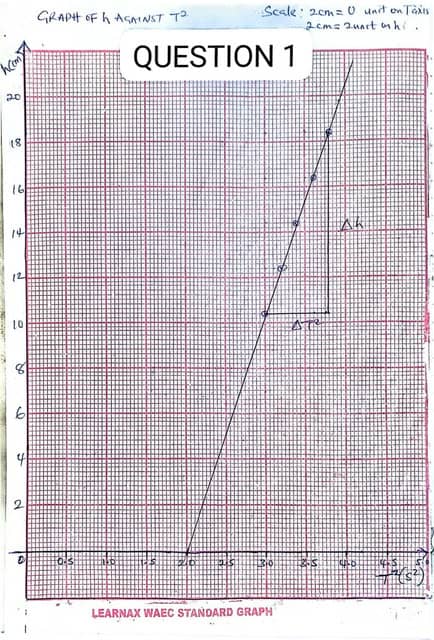
2026 NECO GCE PHYSICS PRACTICAL ANSWER
(1)


============================
(3)


 |
 |